The bridge
For Whom the Bell TollsThe bridge is the central physical objective of Robert Jordan’s mission and the point where military planning meets its human cost. Spanning a gorge on the pass road, it must be destroyed at daylight in coordination with an attack; its demolition succeeds, but the blast kills Anselmo and the operation leaves two men lost at the sawmill. Its fixed position turns the surrounding road, posts, slopes, and gorge into parts of one dangerous problem, while the moment of its destruction converts a planned act of sabotage into an irreversible loss.
Structure and Setting
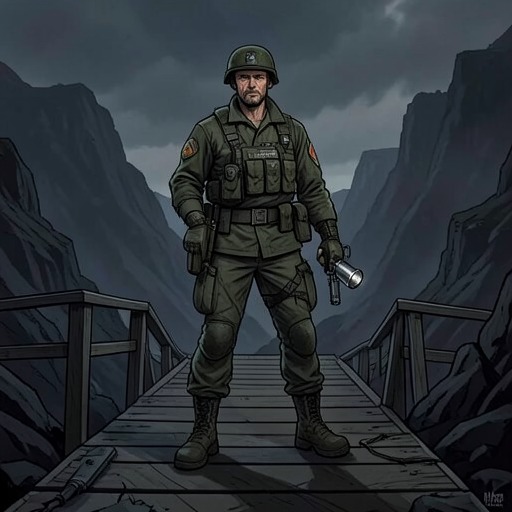
The bridge first enters the narrative as part of a landscape viewed from the forested mountainside. From above, Robert Jordan can see the dark road winding through the pass, a stream beside it, and a mill near the water. When he later approaches the crossing, it is about fifty yards away: a steel bridge of a single span, with a sentry box at either end, spanning a deep gorge. A brook runs over rocks far below toward the pass’s main stream. The crossing is wide enough for two motor cars to pass, but the exposed height and guarded approaches make it more than a piece of road infrastructure: it is a point where movement can be watched, interrupted, and attacked.
The light and terrain shape how the bridge can be understood and approached. In the late afternoon, the sun initially leaves it in silhouette; as the glare fades, Robert Jordan studies its construction and sketches the points where charges could sever the span’s support. He considers either half a dozen smaller charges placed and braced to explode together or two very large charges on opposite sides. At dawn, he sees the structure again from the pine slope above the road, its steel line and sentry boxes emerging through mist from the stream bed. The change from afternoon study to morning execution gives the crossing two distinct aspects: first a technical problem to be solved, then a guarded target in a landscape where visibility and exposure determine what can be done.
The Bridge as a Military Objective
Robert Jordan’s task is not simply to damage a crossing. The bridge must be destroyed in relation to a larger attack, and the timing is part of the mission’s danger. El Sordo explains that demolishing it at night would be easier; because the operation has to take place at daylight, the consequences are grave. Robert Jordan accepts the difficulty rather than treating the timing as an adjustable detail. The bridge therefore concentrates the conflict between an operational order and the practical limits faced by the people expected to carry it out.
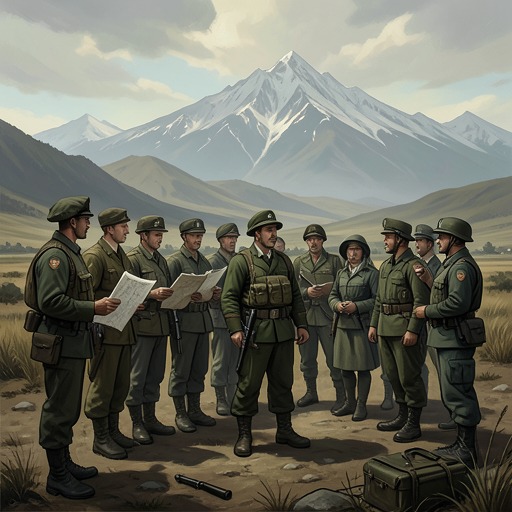
The surrounding positions are tied to the bridge’s demolition. Robert Jordan’s instructions include cutting the telephone, attacking the post at the roadmenders’ house, taking it, and falling back on the crossing. Later, he tells Pilar that the post must not be attacked until she hears the bombs; after the post is destroyed, her group is to fall back onto the bridge and cover the road from above and his left flank. These instructions make the bridge the operation’s intended point of convergence: the attack on the post, the control of the road, and the demolition itself must be coordinated rather than undertaken as separate actions.
The mission also reaches beyond the principal crossing. Robert Jordan says that the common dynamite brought by El Sordo can be used to blow a smaller bridge above it, although he has no order to do so. That additional proposal shows how the road network affects the plan: destroying another crossing may contribute to the effort to obstruct movement, but it does not replace the principal objective. The bridge remains the defining task around which he organizes the available men and equipment.
Planning Under Constraints
As Robert Jordan works through the plan, the bridge becomes a mental as well as geographical focus. He imagines the sentry posts, the road, the placement of two automatic rifles, the charges wedged and lashed into position, the wires, and the exploder. The sequence is exacting and material: the demolition depends on where the charges cut the support, how they are held in place, and whether the firing positions can cover the approach. His technical concentration offers a moment of clarity, but it also brings the consequences of the plan into view. The people he must use are not interchangeable troops to him, even though successful coordination requires him to organize them as such.
That cost becomes harder to ignore after El Sordo’s position is attacked. Robert Jordan recognizes that the force available may be insufficient to take both posts. He fears that trying to do so could kill the members of the group without getting the bridge blown. The risk is not merely that the demolition might fail: the plan could spend the people needed to carry it out and still leave the objective intact. His doubts expose the gap between the mission’s clean outline and the uncertain conditions on the ground, where a plan formed for one set of circumstances can become untenable when daylight, losses, and limited numbers change what can be attempted.
Robert Jordan does not abandon the mission. He writes a report to Golz and reasons that he must not blow the bridge before the attack begins; if the attack is called off, he is to blow nothing. At the same time, he has to retain enough people to carry out the order if it proceeds. This conditional command makes the crossing a test of discipline and trust as much as engineering. Robert Jordan asks for confidence and obedience even when orders appear wrong, explaining that the group is working toward victory and that, in combat, appearances may not reveal what is necessary. The bridge’s destruction is thus bound to a larger military purpose whose full rationale is not available to every participant on the ground.
Demolition and Consequences
At daylight, Robert Jordan climbs into the bridge’s framework with wire around his arm and pliers at his wrist. Anselmo passes him the explosive blocks one package at a time. Robert Jordan places and braces the charges between the girders, using newly whittled wedges to hold them, then lashes them tight with wire. The sequence turns the earlier sketches into physical work carried out under pressure. As he works, fighting is heard at the post on the road; the bridge is not being prepared in safety, but amid an operation already unfolding around its approaches.
After placing the charges, Robert Jordan climbs back onto the bridge and pays out the wire as he moves along it and away from the crossing. The road below remains clear as he retreats toward Anselmo’s position. Then a truck comes down the road. Robert Jordan calls for Anselmo to blow the charges, and the middle of the bridge rises before settling away. The explosion leaves the center section gone and jagged steel scattered across the road. The truck stops farther up the road, and its driver and two companions run toward a culvert. The bridge has become impassable at its center: the objective is achieved at the moment that its former continuity is visibly broken.
The success is inseparable from the loss. Anselmo is found dead behind a roadside marker, with the wire still looped around his fist. Robert Jordan confirms his death but does not turn him over to inspect what the falling steel has done. He picks up Anselmo’s carbine and the nearly empty sacks, gathers another rifle beside Fernando, and starts up the slope into the trees. Later, Pilar tells him that the bridge is blown and reminds him that two men were lost at the sawmill. His reply that he has forgotten nothing registers the result without undoing it: the crossing is destroyed, the road is interrupted, and the people who carried the order forward have paid for its completion.
Narrative Significance
The bridge gives the mission a concrete shape. It can be studied, sketched, approached, wired, and finally destroyed; yet each technical step is inseparable from the question of who must carry it out and what the operation may cost. The contrast between Robert Jordan’s precise plans and the uncertainties of daylight, enemy movement, and dwindling numbers prevents the demolition from reading as a simple triumph of expertise. The object is a military target, but it also marks the limit of what planning can control.
Its destruction is both the mission’s completed action and a rupture in the route through the pass. Before the blast, the span carries a road across a gorge; afterward, its center is gone and broken steel lies across the approach. That physical change answers the order, but it cannot restore the lives lost in executing it. The final reminder that the bridge has been blown therefore carries two truths at once: Robert Jordan has accomplished the task, and accomplishment has not spared the people who made it possible.